
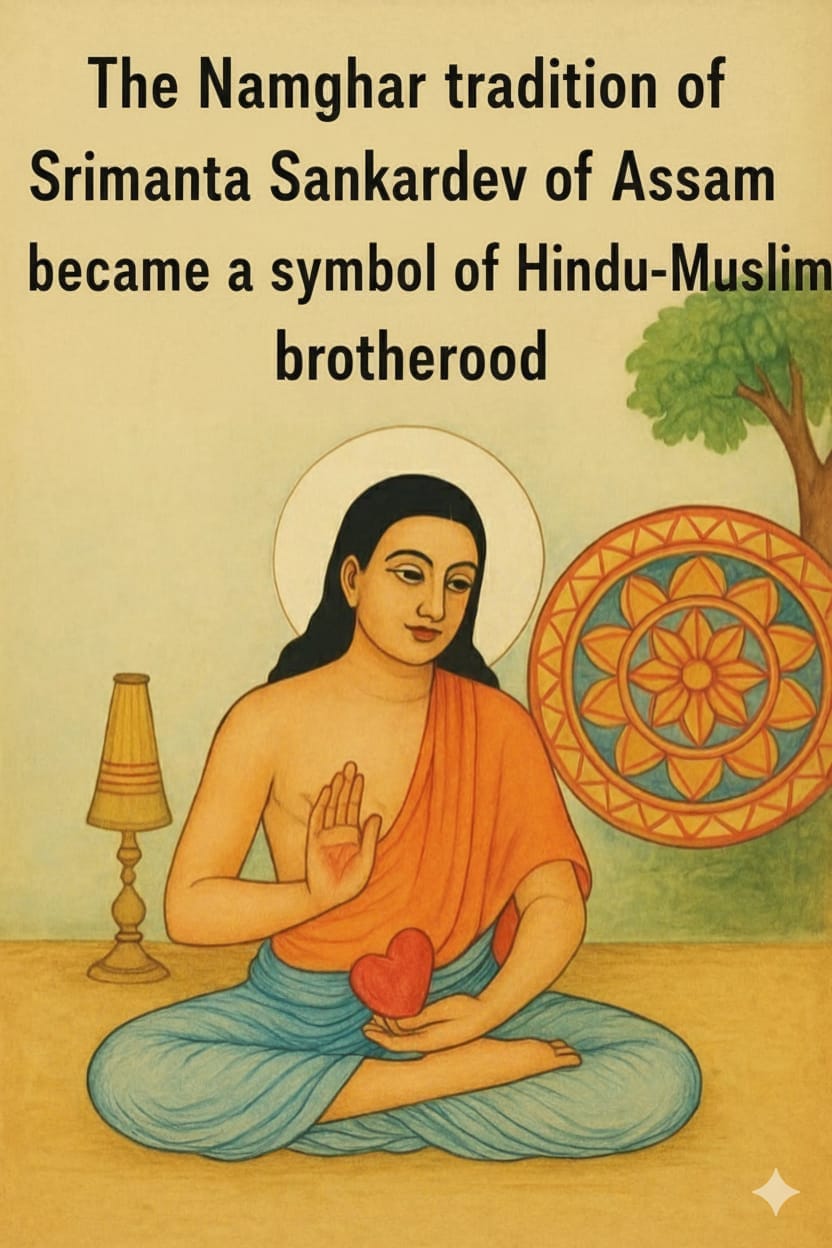

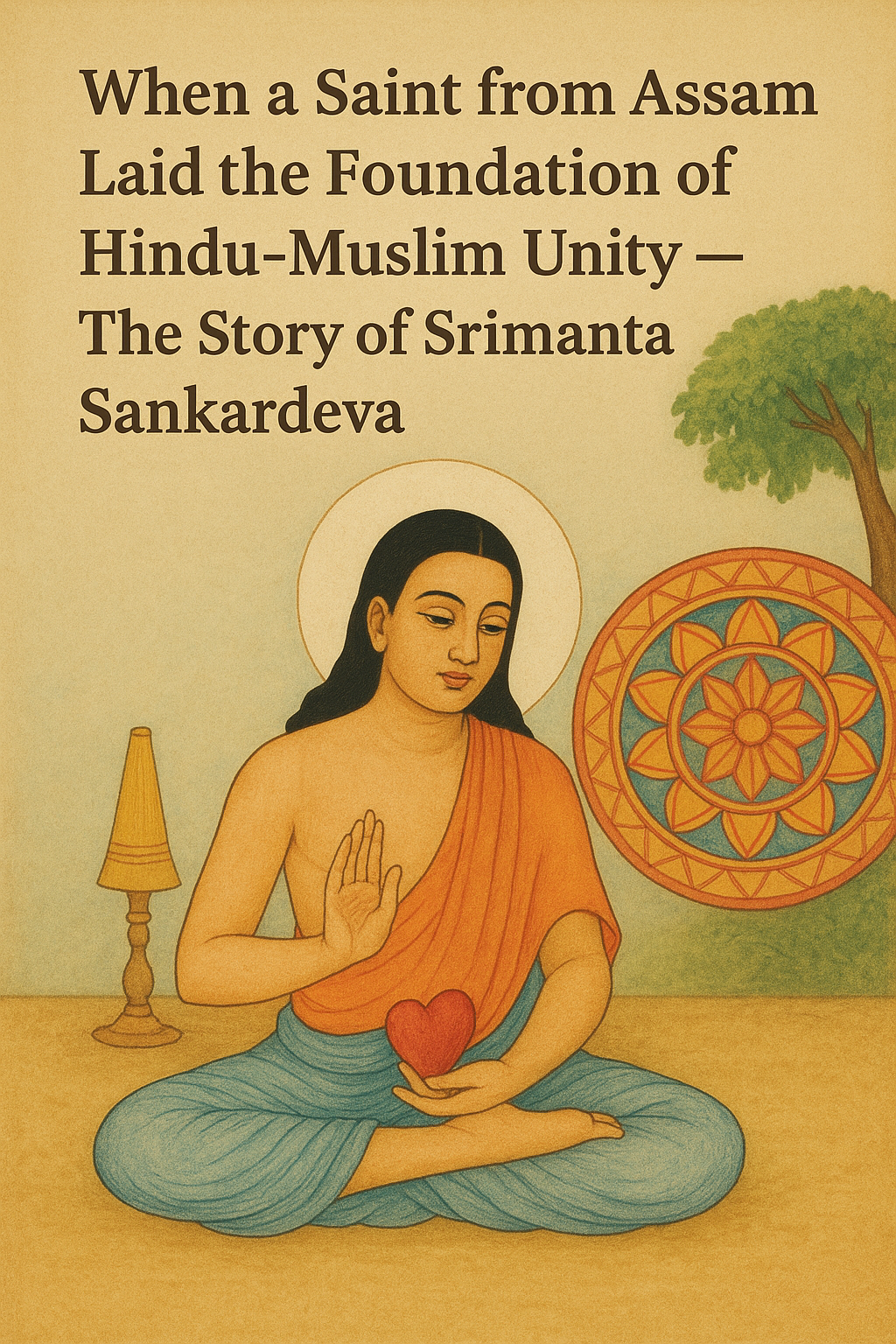
lost his parents early in childhood and was raised by his grandmother Khersuti.
After receiving his education, he devoted himself to knowledge and spiritual
practice, laying the foundation of a new Bhakti Movement in Assam. His
central religious philosophy was “Eka Sharan Naam Dharma” (Ekasarana
Dharma) — emphasizing “One God, One Refuge, None Equal.”

AND DEVOTION
Dharma,” was not based on any sect, caste, or ritualistic worship, but on the
concept of one God, one name, and one refuge.
worship.
service, not rituals or caste identity.
These four principles turned Bhakti
(devotion) into a way of life rather than mere worship. His movement made
common people realize that religion does not mean temples, caste, or priests —
it means love, compassion, and equality.
and untouchability, Sankardeva declared — “God is One, His names are many, and
Love is the only truth.” Through his sermons, Naamghars (community prayer
halls) and Satras (monastic centers), he taught that a person’s worth is
determined by deeds, devotion, and service, not by birth. These centers
welcomed people of all castes, creeds, and genders — Hindus and Muslims, men
and women — all united in collective worship.

(Naamghar and Satra — Assam’s Social
Revolution: A Satra is a monastic institution that follows the
Neo-Vaishnavite tradition in Assam, while a Naamghar serves as its prayer hall
and community center. Together, they are vital to Assamese culture and spirituality.)
Opposition to Superstition and
Ritualism: Sankardeva opposed idol worship, animal sacrifice, witchcraft, and
other superstitions. He taught that God is attained not through rituals but
through truth, love, and service. He guided people to abandon ostentation
and follow simple devotion and moral living, fostering a culture of
ethics and humility.
OUTLOOK
He composed Kirtan Ghoxa, Bhagavat Kirtan, and Ankiya Naat in the
Assamese language to make spirituality accessible to all. He encouraged women’s participation in religious and cultural activities — a progressive
act for his era. In his theatre and devotional gatherings, women were treated
with respect and equality.
Major Plays (Ankiya Naats): Chinha
Yatra, Parijat Haran, Kaliya Daman, Ram Vijay, Rukmini Haran, Keli Gopal, and
Patni Prasad — plays that combined music, dance, and drama to convey spiritual
messages.
Music and Dance: He introduced Borgeet (devotional songs in praise of God) and founded Sattriya
Nritya, now recognized as one of India’s classical dance forms.
UNITY
were among his followers and actively participated in Naamghars. He preached
that true religion does not lie in rituals but in love, service, and
righteous living. He declared — “The same divine light resides in every
being.”
His vision laid the foundation for religious harmony and social solidarity in Assam. Among his prominent
disciples were people from diverse communities — Chandsai (a Muslim), Govinda
(a Garo), Paramanda (a Miri), Jayananda (a Bhutia), Narahari (an Ahom), Madhav
(a Jaintia), and Damodar (a Bania). This diversity reflects that Sankardeva’s
Bhakti Movement was not just spiritual but also a symbol of social unity and
inclusiveness.
Impact on the Muslim Community
Historical and sociological studies show that a large proportion of Assam’s local Muslims (Assamese Muslims) have been influenced by Sankardev’s teachings.
Many Muslim communities participated in Namghar cultural activities—such as bhajans, dances, kirtans, and dramas (Ankiya Nat).
A syncretic culture developed in Assam, which locals refer to as “Ekota Sanskriti” or “Assamese identity.”
Historical Examples
Some Muslim poets and folk singers (such as Sheikh Fakir, Gopal alias Gafur, Dawood Khan, etc.) drew inspiration from the kirtans and devotional literature of Sankardev and Madhavdev.
Even today, in some villages, Muslims participate in Namghar festivals or Bhauna (religious dramas)—though they may not consider them religiously worshipful, they respect them culturally.
This is called Assam’s “shared heritage.”
The Muslims of Assam not only appreciated Sankaradeva’s Naamghar tradition but also embraced it culturally.
This is proof that the spirit of cultural unity and brotherhood, transcending religion, has been very strong in Assam.
1. “The Neo-Vaishnavite Movement and Satra Institution of Assam” – Maheswar Neog
The eminent historian and litterateur of Assam, Maheshwar Neog, has elaborated on how Sankaradeva’s Bhakti movement influenced not only Hindus but also local Muslims.
He writes that Naamghar and Satra institutions became “communal harmony centers” of Assamese society.
2. “Srimanta Sankaradeva: His Life, Philosophy and Works” – Edited by B.K. Saikia
This collection contains several articles that reflect Sankaradeva’s humanistic and all-religious vision.
It explains how “Eka-Sharan-Dharma” (one-sharan-dharma) made no distinction based on caste or religion.
3. “Religion and Society in Assam” – Amalendu Guha
The renowned historian Amalendu Guha has written that Assam’s folk culture blended Islamic and Vaishnavite elements, creating an “Assamese national identity.”
He describes the Namghar as a “socio-cultural institution” that also witnessed Muslim participation.
4. Dr. S.N. Sarma – “The Neo-Vaishnavite Movement and Its Socio-Cultural Impact”
This book, based on the sociological impact of the Sankardev movement, explains that Namghars were not merely religious sites but centers of folk culture—where Assamese Muslims also participated in festivities.
5. Research Papers & Local Studies “Syncretic Traditions in Assam” – Journal of North East India Studies
“Muslim Participation in Satriya Culture of Assam” – Published in Gauhati University Journal
These researches describe how both communities participated equally in festivals such as Bhauna (religious drama), Kirtan, and Bihu.
6. Oral Traditions
Many Assamese villages have folktales and songs where “Miyan Muslims and Namgharia Hindus” celebrate festivals together.
Examples: Such examples are still seen in the Barpeta, Nowgaon, Gohpur, and Golaghat areas.
influencing education, culture, and social unity. Today, every Assamese village
has a Naamghar — living symbols of his legacy. To honor him, the Government of
India established the Srimanta Sankaradeva Kalakshetra in Guwahati,
preserving his art, philosophy, and life’s work.
Srimanta Sankardeva was more than a
religious leader — he was a social reformer, educator, and unifier. Through
Bhakti-based social reform, equality-driven religious education, literature in
the people’s language, and harmony among all faiths, he reshaped Assam’s
identity. His life continues to remind us that the true purpose of religion is
to unite, enlighten, and lead humanity on the path of compassion and
justice.