
✍️ Lieutenant. Preeti Mohan
20 Similarities between Hindu and Greek History That Will Take You By Surprise
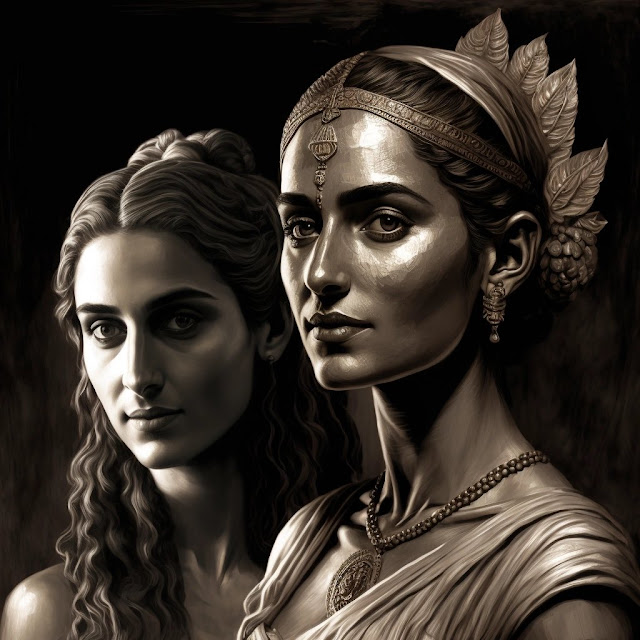
Both Hindu and Greek religion are very old religion known to mankind. At first glance, Greek and Indian history seems to have nothing in common. But if we dig enough, we can find many shocking similarities between the two vastly different beliefs. Below, a few examples are explained.
1. Zeus and Indra: – The most prominent parallel that anyone can think of is how significantly Zeus and Indra match one another. Not only they are King of Gods in their own terms, but even their weapons are extremely similar.

The abodes of both the gods are also largely the same, Lord Zeus resides on Mount Olympus and Lord Indra resides on Mount Meru.
2. Achilles and Karna: – Karna (Hero of the Mahabharat) and Achilles (hero of the Trojan War) also have various similarities. Their weapons are the same.

They both possessed a kind of impenetrable armour that nearly rendered them winner. They were each of the best soldiers in their respective epics. Besides, both were gods and both took permission from their respective mothers to go to war. Achilles has also been compared with Bhishma, because both were born to a water goddess.
3. The Trojan War and Ramayana: – There is a lot of similarity between the two great battles of the two countries. The basis of India’s Ramayana and Greek’s Trojan War is woman.

The Trojan War broke out when Helen fled with Paris, while the Ramayana happened after Ravana abducted Sita.
4. The Holy Trinity: – Both the countries have the principle of three main Gods. The three main deities in India are Lord Brahma, Lord Vishnu and Lord Mahesh.

Similarly, according to Greek belief, the three main gods are Lord Zeus (God of Heavens), Lord Hades (God underworld) and Lord Poseidon (God of Seas).
5. A God for everything: – There is a God for everything in both of these histories, which is a shocking similarity. They had a God of prosperity, knowledge, and the underworld much like us.
6. Hades and Yama: – Characters Hades and Yama share a lot in common. They both control the underworld such as lords.

7. Saptarishis and the Seven Sisters: – They believe in the seven sisters, as we do in the Saptarishis. The Saptarishis are seven bright stars that can command even the Sun, according to our epics.

In Greek tradition, these seven sisters are known as the Pleiades. Just like the Saptarishis, they are also a cluster of stars.
8. Icarus and Sampati: – The story of Icarus and Daedalus and the story of Jatayu and Sampati are also having similarities. One day when they were flying high in the sky, Jatayu went too close to the sun, so Sampati, in order to save Jatayu, went after him. Although he did save Jatayu but, in the process, his own wings got burnt because of the heat of the sun and he fell straight to the ground.

One the other side, Icarus ignored his father’s warnings and flew too close to the sun. His wings melted and he fell into the sea where he met his end.
9. Hermes and Narada: – They both serve as communicators and are descended from the two most potent deities in each of their respective histories. Hermes is son of Lord Zeus and Narad Muni is son of Lord Brahma.

They share a lot of similar characteristics traits as well. Both of them can be clever and cunning at times. Both of them have a reputation for deceiving and misleading others with their words.
10. Poseidon and Varuna: – Both of them possess the power to control water. Varun is the God of seas, river and aquatic life and Poseidon is also the God of seas, river and horses. Poseidon carries the Golden Trident as his weapon whereas Varuna carries Pash.

11. Ares and Kartikeya: – Ares and Kartikeya are the both Gods of war. Ares was one of the twelve Olympian gods and the son of Zeus and Hera while Kartikeya, the son of Lord Shiva and Parvati, is considered as commander chief of devas as he was mainly created to destroy demons.
12. Rishi Kashyap and Kronos: – Good and evil are born out of the same person in both these histories. An interesting fact is that good and evil are fathered by the same person.

Rishi Kashyap was the father of Devas and the Asuras in the Hindu trust. While in Greek trust, the Olympian Gods and the Titans were both fathered by Kronos.
13. Goddess Lakshmi and Hera: – Lakshmi is considered to be the goddess of wealth and prosperity in Hindu culture, similarly, Hera, Zeus’s sister, and wife on the same position in Greek culture.

14. Athena and Saraswathi: – Both Athena and Saraswathi are the Goddesses of Wisdom and Learning. They are also the Goddesses of Culture and Knowledge.

15. Good vs Evil: – In both cultures, there is a constant fight between Good and Evil. In Hindu Dharma, the good is represented by Devas, i.e., the Gods, whereas the demons as Asuras, the chief tormentors of the Devas. Similarly in Greek culture, the gods of Mt. Olympus represents good while their oppositions are the Titan, representing evil.
16. Hephaestus and Vishwakarma: – They both are the chief architect and God of machines in their respective history. It is said that weapon of Lord Indra is made by Vishwakarma in Hindu religion. Similarly in Greek context, Lord Zeus’s weapon is made by Hephaestus.

17. Cerberus and Sharvara: – Sharvara is a famous hound from hell whose owner is Lord Yama. The Greek counterpart to this is the Cerberus that accompanied Hades, both of which guard the gates of the netherworld.

18. Kamadeva and Cupid: – The gods of love and desire, both Kamadeva and Cupid shoot arrows into the hearts of unsuspecting people to make them fall in love.

19. Minotaur and Nandi: – Both Minotaur and Nandi is half man, half bull. In Greek history, the Minotaur is a creature portrayed during classical antiquity with the head and tail of a bull and the body of a man. Similarly, Lord Shankar’s rider Nandi is also half bull and half man.

20. Muses and Gandharvas: – Gaia (Gaea) was the goddess of the earth. She was one of the primordial elemental deities born at the dawn of creation. She’s often referred to as the Earth goddess. In Greek trust, Gaia was the second being to have emerged during the creation of the universe. Similarly, Bhudevi also represents earth goddess.
It is astonishing that the oldest religions has so many similarities, these similarities demonstrate that people are essentially the same everywhere in the world.