
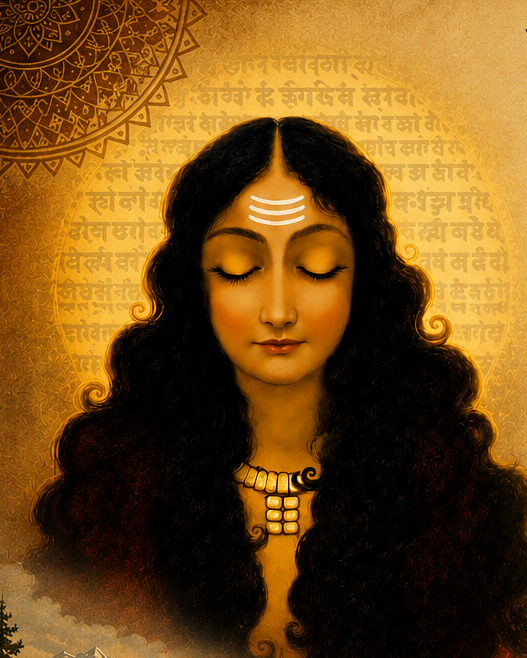
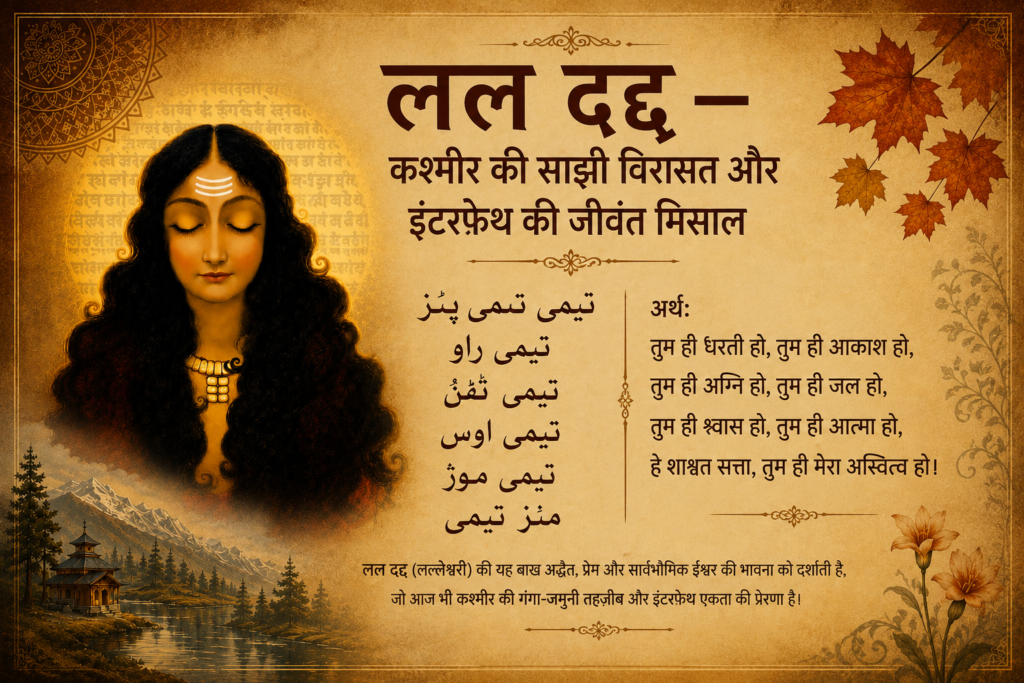
The land of Kashmir has historically been a beacon of love, tolerance, and spirituality. The greatest icon of this composite heritage and inclusive culture (Kashmiriyat) is the 14th-century mystic saint-poetess Lal Ded. Deeply revered across generations, she is affectionately known by many honored names, including Lalleshwari, Lalla, Lal Arifa, and often referred to as the “Mira of Kashmir” or “Rabia of Kashmir.” In today’s world, where societal divides along religious lines are frequently discussed, Lal Ded’s life and verses illuminate the path of Bain-ul-Mazahib—true interfaith harmony.
Early Life and Spiritual Journey
Lal Ded was born in the 14th century into a Kashmiri Pandit family near Pampore, Kashmir. Married at a very young age, she endured severe emotional and physical abuse at the hands of her mother-in-law and husband. According to popular local folklore, her mother-in-law would hide a stone beneath a thin layer of rice in her plate—a hardship that gave birth to the famous Kashmiri proverb: ‘Lali Neelavath Chali Na Janh’ (No matter what delicacies are served, the stone in Lalla’s plate never changes).
Despite these severe familial trials and worldly attachments, her inner spiritual quest remained unquenched. She eventually renounced household life, taking the path of asceticism, yoga, and self-realization in pursuit of the Supreme Lord (Param Shiva).
Through her poetic verses—known in Kashmiri as ‘Vaakhs’—Lal Ded struck a powerful blow against prevailing social evils, religious hypocrisy, caste rigidity, and ritualistic ostentation. She taught that God is not to be found in temples, mosques, or ritual pilgrimages, but within one’s own inner self. Her divine realization is captured in this renowned Vaakh:
“Shiv Chui Thali Thali Roze, Na Zani Myoni Kyah Gav” Meaning: Shiva abides in every particle of the universe; foolish as I was, where was I searching for Him outside?
The Hindu-Sufi Confluence and the Philosophy of ‘One Light’
Lal Ded’s life and philosophy represent a sublime example of the Hindu-Sufi confluence in Kashmir. Although born into the Kashmiri Shaivite tradition, her Vaakhs reflect the profound spiritual depth of Sufi Tasawwuf. Emphasizing non-dualism (Advaita) and monotheism, she taught that humanity originates from a single divine source:
“Ek Nooras Pe Sab Jag Bunyo, Kus Myoni Kus Kor” Meaning: The entire universe is woven from a single divine light (Noor); who then is mine, who is alien, who is good, and who is bad?
Her simple, unpretentious nature earned her immense respect from contemporary Sufi saints. It is believed that she met the famous Sufi saint Mir Sayyid Ali Hamadani. Furthermore, she shared a deep spiritual bond with Sheikh Noor-ud-Din Wali (Nund Rishi), the patron saint of Kashmir. According to legend, when infant Nund Rishi refused to nurse from his mother at birth, Lal Ded nursed him herself, initiating him into the worldly life.
This inclusive vision transformed Lal Ded into a powerful bridge between Islam and Sanatana Dharma. To this day, she is revered equally as ‘Lalleshwari’ by Hindus and ‘Lal Arifa’ by Muslims. Her ashram in Bijbehara stands as a living testament to this interfaith tradition, where people from both communities bow their heads in deep reverence. Her philosophy aligns seamlessly with the Quranic concept of “Deen-e-Qayyim” and the timeless truth of “Sanatana Satya.”
Relevance in the Contemporary Era
In an era where religious divides seem to be widening, Lal Ded’s message of interfaith harmony (Bain-ul-Mazahib) is more relevant than ever. What she articulated 700 years ago remains essential for the peace and cohesion of South Asia today. She rejected division in the name of religion and placed humanity above all dogma. She taught that when an individual achieves self-knowledge, prejudice and hatred naturally vanish. This profound truth is reflected in her famous verse:
“Aatm Panay Tamyo, Parmeshwar Chukhu Na Byo” Meaning: When I realized my true Self, I saw nothing other than the Supreme Lord. Her words serve as a timeless lesson in love, compassion, and human oneness amidst times of discord.
Lal Ded was not merely a saint or a poet; she was a spiritual and social movement in her own right. By composing her verses in the local Kashmiri language instead of the complex classical Sanskrit of her time, her message directly touched the hearts of the masses.
Today, there is a vital need to take Lal Ded’s Vaakhs and her philosophy of universal love into every household. As long as the inclusive, shared heritage of Lalleshwari lives on, Kashmir and the broader region of South Asia will continue to thrive in mutual brotherhood and peace.