
On the occasion of Guru Nanak Jayanti, let us resolve to live in accordance with the principles of Sri Guru Nanak Dev Ji and contribute towards making South Asia stronger and more prosperous.
Author: Sunil Dutt (Former Director, Punjabi Sahit Akademi)
From the cultural consciousness of Punjabiyat to the future of India, Pakistan, Afghanistan and Central Asia, the teachings of Guru Nanak Dev Ji are not merely a matter of religious faith; they also provide an important foundation for trust, dialogue and coexistence among civilisations.
The future of India and South Asia will not be determined solely by political boundaries, military strength, economic capabilities or international agreements. It will also depend on how the societies living in this region perceive their shared civilisational heritage. Will they understand history only through conflicts, invasions, divisions and religious differences, or will they also draw guidance from the teachings of saints, Gurus, Sufis and thinkers who have connected the diverse communities of this region for centuries?
The philosophy of Sri Guru Nanak Dev Ji is one of the most significant expressions of this second approach.
Understanding Guru Nanak Dev Ji merely as the founder of Sikhism would limit the broader scope of his historical and civilisational contribution. Undoubtedly, he holds the highest and a distinct place in the spiritual tradition of Sikhism. However, the principles of truth, equality, dignity of labour, service, compassion and human unity expressed in his teachings open possibilities for dialogue far beyond religious boundaries.
At a time when relations between India and Pakistan are affected by mistrust and complex security concerns, Afghanistan continues to grapple with the consequences of prolonged conflicts, and efforts are underway to explore new routes of connectivity and trade with Central Asia, understanding the legacy of Guru Nanak Dev Ji as a shared cultural and ethical resource becomes particularly relevant.
1. Guru Nanak: A Civilisational Vision Beyond Religious Identity
One of the most important characteristics of Guru Nanak Dev Ji was that he connected spirituality with everyday human conduct and social responsibility.
His philosophy places particular emphasis on the oneness of God, human dignity and a truthful way of life. The essence of his message was not to establish the superiority of any one religious community, but to liberate human beings from ego, discrimination, injustice and narrow-mindedness.
An important message found in the hymns of Guru Nanak Dev Ji, compiled in Sri Guru Granth Sahib, is:
Aval Allah Noor Upaya, Kudrat Ke Sabh Bande. Ek Noor Te Sabh Jag Upjeya, Kaun Bhale Ko Mande.
These are the verses of Bhagat Kabir Ji, which have been included in Sri Guru Granth Sahib. Their meaning is that the entire creation has emerged from one divine light; therefore, there is no justification for considering human beings superior or inferior on the basis of their birth or religious identity.
This brings us to one of the unique features of Sri Guru Granth Sahib. Along with the teachings of the Sikh Gurus, it also contains the hymns of saints and devotees from diverse social and religious backgrounds. These include the compositions of Kabir, Sheikh Farid, Ravidas, Namdev and several other saints.
Its significance is not limited to religious tolerance. It represents a spiritual outlook in which the search for truth is not considered the intellectual or religious property of any single community.
This legacy holds particular importance for South Asia. Here, religious diversity is not a modern political experiment but a social reality that has evolved over centuries.
2. Punjabiyat Cannot Be Understood by Limiting It to Sikh Identity
Punjabiyat is a broad cultural consciousness. It has evolved through language, folk music, literature, agriculture, trade, labour, shared memories and the long-standing interaction of different religious traditions.
Along with the teachings of the Sikh Gurus, the cultural soul of Punjab also reflects the contributions of Baba Farid, Bulleh Shah, Shah Hussain, Waris Shah and numerous other Sufi and folk traditions.
Therefore, it would not be appropriate to treat Punjabiyat as synonymous only with Sikh religious identity. Similarly, it would also be inappropriate to absorb the independent religious identity and distinct traditions of Sikhism entirely into a regional culture.
The two are deeply connected, but neither is synonymous with the other.
The contribution of Guru Nanak Dev Ji is particularly important in understanding this cultural consciousness because he inspired people to view human relationships, alongside religious identity, through dialogue rather than competition.
Traditions such as Langar, Seva, shared labour, hospitality and community cooperation have strengthened social bonds in Punjab. These traditions did not all originate from a single source, but the teachings of Guru Nanak Dev Ji and the succeeding Sikh Gurus gave many of these values a distinct institutional form.
Punjab was politically divided in 1947, but the Punjabi language, music, literature, folk memories and historical cultural connections continued to survive on both sides of the border.
The Punjabi language itself represents a rich linguistic tradition, with different forms and dialects developing across various regions. Majhi, Malwai, Doabi, Dogri, Pothohari, Multani, Saraiki, Himachali, Jhangvi, Hindko, Dhanni, Kangri, Pahari (Mirapuri), Bagri and Puadhi are not merely different ways of speaking; they also carry the geographical, social and cultural experiences of Punjab. Beyond the present-day Indian and Pakistani Punjab, the Punjabi language is also connected to wider linguistic interactions and cultural exchanges. This diversity gives Punjabiyat a living and multidimensional identity.
This shared heritage can serve as a potential foundation for cultural dialogue between India and Pakistan, provided that no attempt is made to claim it as the exclusive property of any one religious or national identity.
Punjab’s cultural consciousness is not limited to religious traditions. Alongside Sri Guru Nanak Dev Ji, historical personalities such as Maharaja Ranjit Singh and Shaheed-e-Azam Bhagat Singh also hold an important place in the history of this region. Each of them, in their respective historical contexts, influenced Punjab’s identity, social consciousness and the broader history of India. Therefore, while understanding Punjab’s heritage, it is necessary to view its spiritual, social, political and national contributions through a broader historical perspective.
3. Guru Nanak’s Travels: A Historical Memory of Dialogue from South Asia to Central Asia
The tradition of the Udasis, or extensive travels associated with Guru Nanak Dev Ji, extends across different regions of the Indian subcontinent and into West and Central Asia.
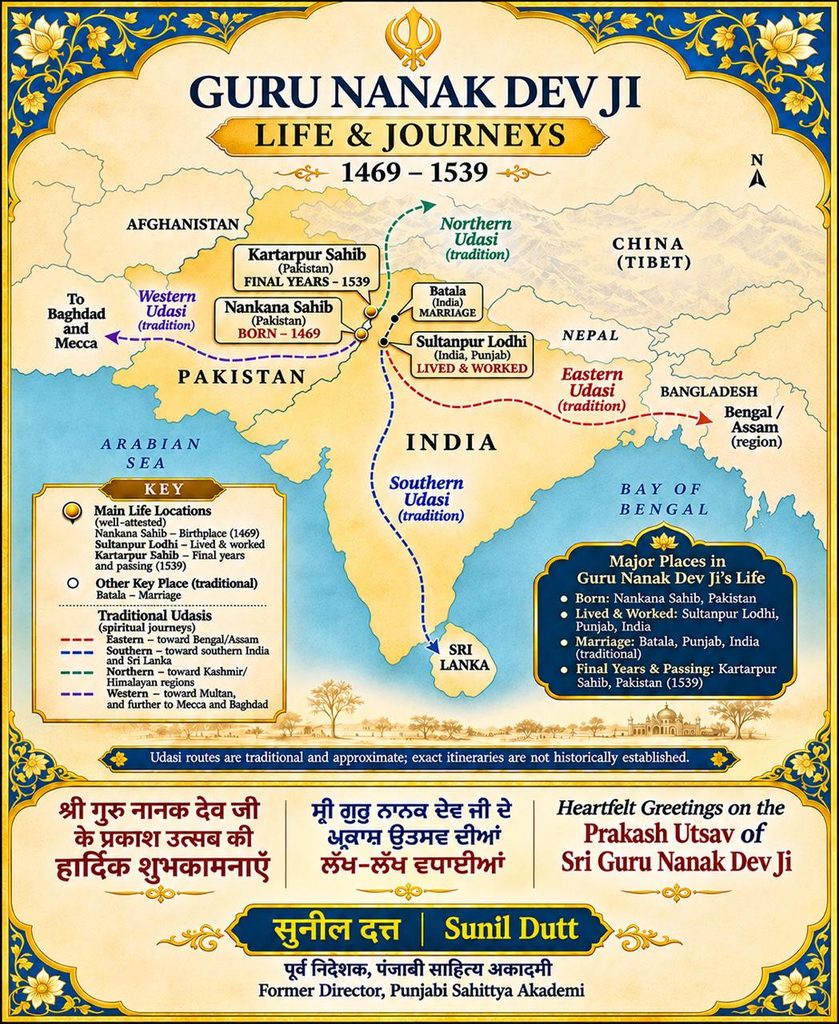
Janamsakhi traditions mention his travels to Haridwar, Kashi, Bengal, Sri Lanka, Mecca, Baghdad and other regions. Historical confirmation of all these routes and details is not available at the same level. Therefore, it is necessary to distinguish between historical evidence and devotional traditions.
Nevertheless, the cultural significance of the memories associated with these travels is noteworthy.
In particular, Nankana Sahib and Kartarpur Sahib, both located in present-day Pakistan, are extremely important places associated with the life journey of Guru Nanak Dev Ji.
The significance of these places is not limited to pilgrimage. They bear witness to a shared history that people in both India and Pakistan preserve in their cultural memory.
Among the accounts of Guru Nanak Dev Ji’s travels, his companion Bhai Mardana Ji holds a special place. The companionship between Guru Nanak Dev Ji and Bhai Mardana Ji, who came from a Muslim background, is an inspiring example of interfaith closeness.
Their companionship conveys the message that deep human and spiritual relationships are possible amidst religious diversity.
Today, while exploring new possibilities for cultural connections between India, Pakistan, Afghanistan and Central Asia, this legacy provides a useful historical reference. However, it would not be historically appropriate to claim that Guru Nanak Dev Ji enjoys the same level of religious devotion across all these regions.
4. India, Pakistan and Afghanistan: Geography Must Become a Medium of Connectivity, Not Conflict
India’s relationship with Central Asia is not merely a matter of modern diplomacy. Ancient trade routes, cultural exchanges, religious journeys and human interactions connected the Indian subcontinent with Afghanistan and Central Asia for centuries.
Partition and the political circumstances that followed have affected these connections.
Geographically, access to Central Asia through Pakistan and Afghanistan represents an important potential connectivity route for India. Although alternative routes, such as Iran’s Chabahar Port and other international transport corridors, are also important for India, practical relations with neighbouring countries will continue to matter for lasting economic integration in South Asia.
Here, a new dimension of Guru Nanak Dev Ji’s philosophy emerges.
He emphasised trust in human relationships, just conduct and collective welfare. A moral vision for modern regional cooperation can be developed on the basis of these values.
This does not mean that spiritual ideas will automatically resolve border disputes, terrorism, security concerns or political differences.
However, religious and cultural dialogue can certainly contribute towards creating a more favourable social environment for political negotiations.
There is no need to consider border security and human trust across borders as opposing objectives.
The real challenge before policymakers in India and Pakistan is to remain committed to their national security and sovereignty while also exploring practical opportunities for shared history and cultural connections.
The teachings of Guru Nanak Dev Ji can serve as an important ethical inspiration for achieving this balance.
5. Kartarpur Sahib: When Spiritual Heritage Showed Diplomacy a Way Forward
Kartarpur Sahib provides a historical example of this possibility.
On 24 October 2019, India and Pakistan signed an agreement concerning the operation of the Kartarpur Sahib Corridor. Both governments agreed to develop a special arrangement to facilitate religious pilgrims.
The significance of this initiative was not limited to providing ease of pilgrimage.
It also demonstrated that, despite serious political differences, the two countries could undertake limited and practical cooperation for a shared religious and cultural purpose.
The Kartarpur experience encourages us to consider an important question:
If an agreement between the two countries was possible for a religious connectivity route in the memory of Guru Nanak Dev Ji, can this same legacy also inspire opportunities for dialogue in other areas, such as education, culture, the environment, heritage conservation and humanitarian cooperation?
This question is relevant not only to India and Pakistan but also to the whole of South Asia.
However, the success of such efforts will depend on the security conditions, political will and mutual trust among the countries concerned.
6. Political Islam, Radical Religious Nationalism and the Question of the Western World Order
One of the major challenges facing modern South Asia is to understand the relationship between religious faith and political ideologies in a balanced manner.
Religion can be a source of spirituality, morality, service and social responsibility in human life. On the other hand, the political use of religious identity can sometimes create polarisation and mistrust among communities.
The history of different strands of political Islam is complex. Its development has been shaped by several factors, including internal religious and political debates within Muslim societies, colonial experiences, the modern nation-state, regional conflicts and the policies of international powers.
During the Cold War, particularly in Afghanistan, external powers supported various Islamic political and armed groups, producing serious and long-term consequences. It is extremely important to understand political Islam as a project created by Western countries.
Similarly, it is necessary to distinguish between the diverse spiritual, philosophical and social traditions of Hinduism and the various political ideologies based on Hindu identity.
Today, there is a need for serious debate on radical religious nationalism, communal polarisation and identity-based political conflicts. The conspiracies of this same Western order are also behind the growing and deteriorating phenomenon of ultra-Hinduism.
An important principle emerges here:
Respect for religious faith and criticism of the political misuse of religion are both possible at the same time.
The spiritual and Sufi traditions of Islam cannot be equated with every strand of political Islam. Similarly, the broad philosophical traditions of Hinduism cannot be confined to a single interpretation of radical Hindu nationalism.
The teachings of Guru Nanak Dev Ji are particularly relevant in this context because they give greater importance to human conduct, truth, justice and humility than to external religious identity.
His philosophy inspires us to move beyond competition for superiority in the name of religion and instead develop a sense of human responsibility through religion.
At such a time, the principle of Sarbat Da Bhala (the welfare of all) taught by Guru Nanak Dev Ji provides an important ideological foundation. This principle is not limited to the welfare of any one religion, community or nation; it speaks of the well-being of all humanity. The lasting answer to religious supremacy, hatred and the politics of division does not lie in another form of extremism, but in equality, compassion, justice and shared human responsibility. From this perspective, the teachings of Guru Nanak Dev Ji have the potential to strengthen religious harmony and social trust in South Asia.
7. The Bhakti Movement: India’s Overlooked Civilisational Soft Power
One of the important sources of India’s cultural and spiritual strength has been its Bhakti, saint, Sufi and Gurmat traditions.
Kabir, Ravidas, Namdev, Mirabai, Chaitanya Mahaprabhu, Guru Nanak Dev Ji and numerous other saints and thinkers connected spiritual experience with popular languages, everyday life and social questions in their respective historical contexts.
There were also significant differences in the religious beliefs and philosophical perspectives of these traditions. Therefore, it would not be appropriate to present them as one uniform ideology.
Nevertheless, several shared human concerns can be found in many of their ideas, such as criticism of ego, spiritual practice, compassion, human dignity and ethical conduct.
This is an important cultural strength of Indian civilisation.
Today, in international relations, the meaning of soft power is not limited to promoting yoga, tourism, food, music, films or cultural festivals. A society’s moral credibility, respect for diversity and ability to establish dialogue also shape its cultural influence.
From this perspective, the teachings of Guru Nanak Dev Ji hold particular significance for India’s cultural diplomacy.
However, one caution is necessary.
Presenting the legacy of Guru Nanak Dev Ji solely as India’s national soft power could limit its wider significance, because this legacy has deep historical connections with present-day Pakistan as well, and holds independent spiritual importance for Sikh communities across the world.
Therefore, a more meaningful approach would be for India to use this legacy respectfully in its cultural diplomacy while fully recognising its universal human spirit and the independent character of the Sikh religious tradition.
Treating shared heritage as a shared responsibility rather than establishing exclusive ownership over it is the essence of genuine cultural diplomacy.
8. Sri Guru Granth Sahib: A Living Foundation for Interfaith Dialogue
The distinctive feature of Sri Guru Granth Sahib Ji is not merely that it contains the compositions of saints from diverse backgrounds, but also that this diversity is honoured within a profound spiritual framework.
The Adi Granth, compiled by Guru Arjan Dev Ji in 1604, included the hymns of various devotees and saints. Subsequently, Sri Guru Granth Sahib Ji came to be established as the Eternal Guru in the Sikh tradition.
This was an extremely important event in religious history.
It provides an opportunity to understand how respectful relationships can be established between spiritual expressions emerging from different religious and social backgrounds.
Today, numerous conferences and institutional programmes are organised in the name of interfaith dialogue. However, genuine dialogue is not achieved merely by bringing religious leaders together on a common platform.
It requires different communities to seriously understand one another’s religious sensitivities, historical experiences, concerns and social contributions.
One important feature of dialogue inspired by Guru Nanak Dev Ji’s teachings could be that it does not seek to erase religious identities. Instead, it seeks to discover shared human responsibilities among different identities.
This approach can be particularly useful in South Asia, where religious identity is deeply connected with language, caste, region, culture and historical memories as well.
9. A Shared Cultural Agenda for Policymakers in India and Pakistan
Inspired by the teachings of Guru Nanak Dev Ji, several practical initiatives can be considered for South Asia.
First, institutional cooperation could be developed for the preservation of sites associated with religious and cultural heritage between India and Pakistan, wherever political and security conditions permit.
Second, joint academic studies on the Punjabi language, literature, Sufi traditions and Gurmat traditions could be encouraged. Universities, historians and cultural institutions in both countries would have an important role to play in this effort.
Third, international research on the travels of Guru Nanak Dev Ji and the historical memories associated with them should be promoted. Such studies should respect devotional traditions while also ensuring independent examination of historical evidence.
Fourth, religious pilgrimages, digitisation of historical documents and cultural heritage conservation could be explored as relatively limited areas with the potential to build mutual trust.
Fifth, dialogues could be developed among academics, religious scholars and civil society representatives from India, Pakistan and Afghanistan, as well as other parts of South Asia. These dialogues should address not only shared human values but also serious questions concerning religious freedom, minority rights and social justice.
Sixth, studies of India’s historical relations with Central Asia should give adequate importance not only to trade routes but also to religious journeys, linguistic connections and cultural exchanges.
It would be more appropriate to view these initiatives not as substitutes for political agreements, but as potential complementary efforts that can strengthen trust and social understanding in support of them.
10. The Responsibility of India’s Religious, Political and Academic Leadership
One of the most important characteristics of India’s civilisational traditions has been their diversity.
This diversity includes the contributions of Vedic, Buddhist, Jain, Sikh, Bhakti, Sufi and numerous local and tribal traditions.
There have been not only areas of agreement among these traditions but also philosophical differences, ideological debates and historical conflicts. Nevertheless, their long-standing interactions helped the Indian subcontinent develop into a rich and pluralistic cultural region.
Today, India’s religious leadership, social institutions, universities, researchers and policymakers face the challenge of studying this heritage not merely to celebrate its glory, but also to understand its relevance in the context of modern social and international challenges.
In particular, the Bhakti and Gurmat traditions should not be confined merely to religious ceremonies, commemorative days or cultural symbols.
Serious academic research should be undertaken into their social philosophy, ethical economy, community service, dignity of labour, environmental sensitivity and ideas relating to interfaith dialogue.
At the same time, respect for religious traditions should not mean avoiding their critical historical examination. A mature society draws inspiration from its heritage while also maintaining intellectual honesty in its study.
This would be the most meaningful way to bring the teachings of Guru Nanak Dev Ji into modern international discourse.
11. The Relevance of Guru Nanak Dev Ji’s Teachings for All Communities of South Asia
The future of South Asia can become more stable and cooperative only when the different linguistic, cultural and social groups of the region respect one another’s identities while making shared human values the foundation of their lives. The teachings of Guru Nanak Dev Ji are relevant to the diverse societies of this entire region, including Marathi, Nepali, Bihari, North-Eastern Indian, Gujarati, Punjabi, Pakistani and South Indian communities.
His message is not limited to any particular ethnic, linguistic or religious community. The principles of Kirat Karo, Naam Japo and Vand Chhako inspire honest labour, spiritual discipline and the sharing of resources. If different communities of South Asia adopt these values in their personal and social lives, mutual trust, cooperation and regional unity can gain a stronger foundation.
South Asia Needs Not Only a Shared History, but Also a Shared Future
The Parkash Purab of Guru Nanak Dev Ji is not merely a commemoration of the birth of a great spiritual personality. It is also an opportunity to reflect on those human values without which no society can achieve lasting peace and prosperity.
India and Pakistan share a history. The language and cultural memories of Punjab are shared. Many of the subcontinent’s religious, literary and philosophical traditions continue to exist on both sides of the borders.
But a shared history does not automatically guarantee a shared future.
That requires justice, security, mutual respect, religious freedom and practical cooperation.
The teachings of Guru Nanak Dev Ji provide a broader ethical vision for these values.
Today, the need is for the societies and policymakers of South Asia to look beyond the politics of identity when viewing their religious heritage and also explore its potential for human cooperation.
The Bhakti movement, Sufi traditions and the spiritual message of Sri Guru Granth Sahib Ji deserve serious consideration in this direction.
If India and Pakistan succeed in understanding their shared cultural history with mutual respect, it could create new possibilities for dialogue at the social level. And if these possibilities receive support through practical policies, institutional cooperation and political wisdom, their impact could extend to broader regional relations.
The legacy of Guru Nanak Dev Ji inspires us to reflect on the idea that the highest social contribution of religion is not to build higher walls between human beings, but to make their relationships more humane through truth, justice and compassion.
This spirit remains relevant today for India, Pakistan, Afghanistan and the wider South Asian region.
And perhaps this is the most important question on this Parkash Purab:
Will we give Guru Nanak Dev Ji a place only in our devotion, or will we also give his teachings a place in our social conduct, relations with our neighbours and vision of our collective future?
Nanak Naam Chardi Kala, Tere Bhane Sarbat Da Bhala.
This conceptual article brings together historical contexts and policy possibilities. The discussion concerning political Islam, religious nationalism and the role of international powers is presented as analysis, rather than as a historical conclusion establishing a single unverified conspiracy.