
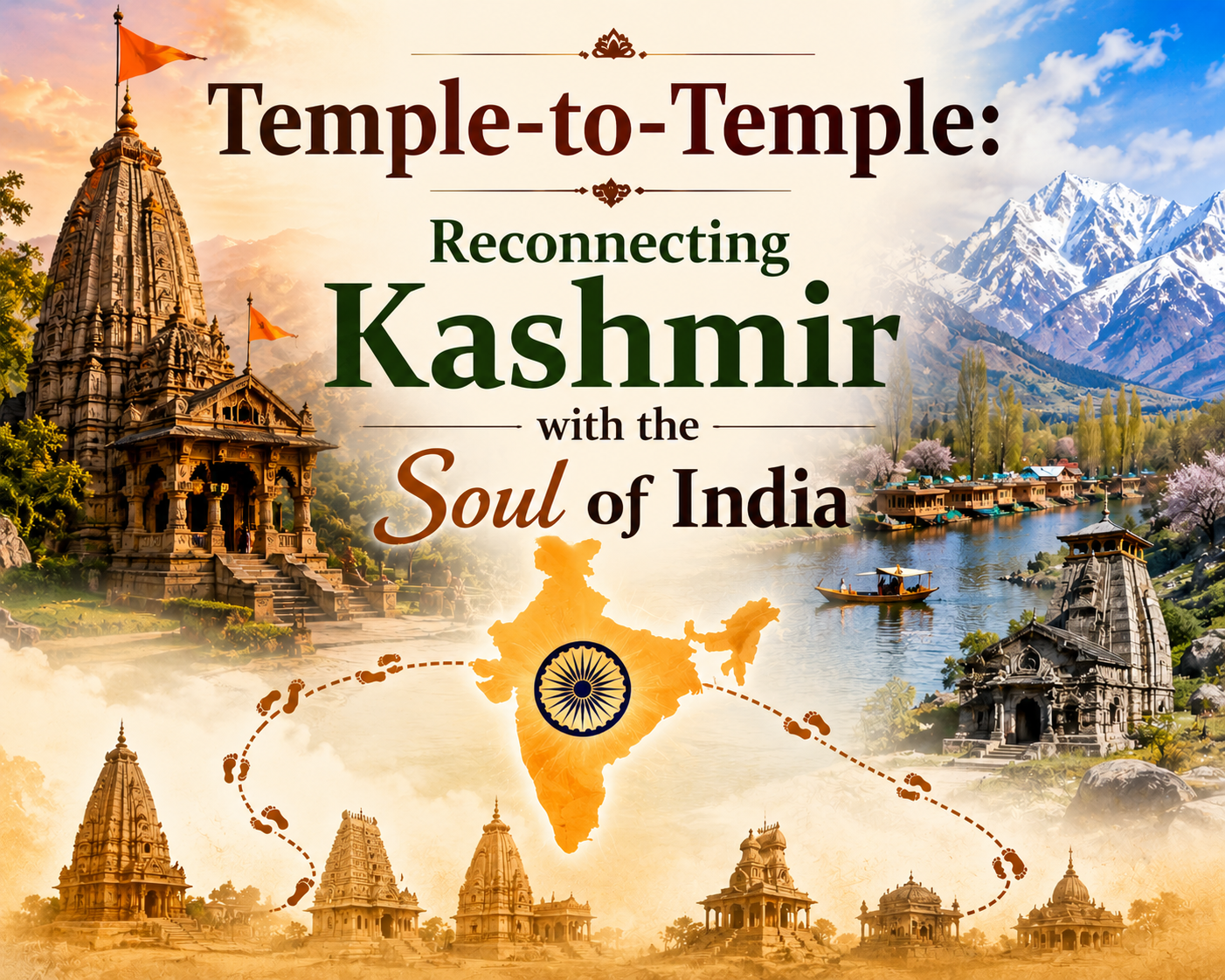
Temple-to-Temple: Reconnecting Kashmir with the Soul of India
A National Civilizational Initiative for Cultural Integration, Heritage Preservation, and Shared Responsibility
Author: Dr Gautam Kaul (E-Mail: gkndri@gmail.com)
There are roads that connect cities, railways that connect states, and digital networks that connect people. Yet the deepest and most enduring connections are those that bind hearts, faith, memory, and civilization. India has remained united through millennia not merely because of political boundaries, but because of an intricate network of sacred geography, pilgrimages, temples, monasteries, festivals, and shared spiritual traditions. Long before modern nation-states emerged, these civilizational bonds created a sense of cultural unity stretching from Kashmir to Kanyakumari.
Kashmir, revered in ancient texts as Sharada Desha, once stood among the foremost centres of Indian civilization. It nurtured Sanskrit scholarship, philosophy, Shaivism, Shaktism, Buddhism, music, literature, and art. Great saints, scholars, and pilgrims travelled to and from Kashmir, enriching the cultural fabric of the entire subcontinent. Unfortunately, decades of conflict, terrorism, displacement, and neglect have left many of Kashmir’s ancient temples abandoned, damaged, or disconnected from the mainstream religious life of the country. While restoration efforts have begun in some places, rebuilding structures alone cannot revive a living civilization.
The time has come to think beyond restoration. What Kashmir needs is not only rebuilt temples but renewed relationships. It requires reconnecting its sacred heritage with the spiritual consciousness of the rest of India.
One simple yet transformative idea can achieve this: every ancient temple in Kashmir dedicated to a particular deity should establish a permanent cultural, spiritual, and institutional partnership with temples dedicated to the same deity across India. Instead of functioning as isolated places of worship, temples would become part of a nationwide network of shared heritage and collective responsibility.
Imagine Bhadrakali Temple in Kashmir being linked with Bhadrakali temples in Kerala, Telangana, Karnataka, Himachal Pradesh, and West Bengal. Imagine every Ganesh temple in Kashmir connected with renowned Ganapati temples in Maharashtra, Tamil Nadu, Karnataka, and Gujarat. Similarly, Ram temples could establish enduring relationships with Ayodhya and other major Ram temples across India, while Krishna temples could partner with Mathura, Vrindavan, Dwarka, Udupi, Nathdwara, and Puri. The same model could naturally extend to Shiva, Durga, Hanuman, Saraswati, Vishnu, and countless other sacred traditions.
This is not merely temple twinning. It is the rebuilding of India’s civilizational network.
Governments can restore monuments. Archaeological agencies can conserve stone structures. Engineers can rebuild walls and roofs. But only people can revive living traditions. A temple truly comes alive not when its architecture is repaired, but when worship resumes, festivals return, pilgrims gather, children learn its history, and communities once again develop an emotional bond with it. Temple-to-Temple partnerships would therefore transform restoration into participation and conservation into living heritage.
Such partnerships could create extraordinary opportunities for shared festivals and religious celebrations. Ram Navami could be jointly celebrated by Ram temples in Kashmir and Ayodhya. Ganesh Chaturthi could witness devotees from Maharashtra participating in festivals at Kashmir’s Ganesh temples. Janmashtami, Navaratri, Shivaratri, and other festivals could become occasions for cultural exchange, joint prayers, online participation, and annual pilgrimages. These celebrations would not merely be symbolic events; they would cultivate a profound sense of shared identity and belonging.
Another significant advantage would be the adoption of heritage. Across India, many temple trusts possess remarkable organisational capabilities and generous devotees willing to contribute towards preserving India’s sacred legacy. Rather than depending solely upon government grants, temple trusts could voluntarily adopt sister temples in Kashmir by supporting restoration, maintenance, landscaping, libraries, museums, pilgrim facilities, digital archives, and educational programmes. Every contribution would become a tangible act of national service rather than simply an act of charity.
The initiative would also create entirely new pilgrimage circuits. Today, millions visit Ayodhya, Kashi, Tirupati, Ujjain, Somnath, Dwarka, Puri, and Vaishno Devi every year. Imagine if pilgrims visiting these destinations were encouraged to also visit the corresponding temple dedicated to the same deity in Kashmir. Such integrated pilgrimage routes would not only revive forgotten shrines but also generate employment, strengthen local economies, encourage heritage tourism, and increase national engagement with Kashmir’s sacred landscape.
The educational possibilities are equally inspiring. Students, priests, temple administrators, historians, artists, volunteers, and devotees could regularly participate in exchange programmes. Young people from Tamil Nadu should know the history of Martand, Avantipur, and Sharada Peeth. Likewise, young Kashmiris should experience the vibrant traditions of Madurai, Udupi, Puri, Dwarka, and Nashik. Civilizations endure when successive generations inherit not only monuments but also living relationships.
Temple partnerships would also help preserve rituals and traditions that are in danger of disappearing forever. Kashmir possesses unique liturgical practices, oral traditions, hymns, architectural styles, and festivals that deserve careful documentation and revival. By collaborating with partner temples across the country, these traditions could be recorded, preserved, and transmitted to future generations before they vanish.
The concept itself is neither unprecedented nor impractical. Around the world, cities establish “sister city” relationships to promote friendship and cooperation. Universities collaborate through academic partnerships. Schools organise exchange programmes. Hospitals share expertise across borders. Businesses create strategic alliances to strengthen one another. If institutions across every field recognise the value of long-term partnerships, why should temples the oldest and most enduring institutions of Indian civilization not embrace a similar model?
Indeed, such a programme would perfectly complement the spirit of Ek Bharat Shreshtha Bharat, which seeks to strengthen cultural bonds between different parts of the country. However, Temple-to-Temple partnerships would take this vision far deeper. These would not be temporary exchanges lasting a few days, but permanent relationships sustained through devotion, heritage conservation, pilgrimages, educational initiatives, and community engagement. A devotee in Kerala would naturally feel connected to a Bhadrakali temple in Kashmir. A family in Gujarat could actively support the restoration of a Krishna temple in the Valley. A temple trust in Karnataka could mentor conservation projects hundreds of kilometres away. This would be national integration in its most natural and enduring form.
For the displaced Kashmiri Pandits, such an initiative carries even deeper significance. Their temples are not merely religious structures; they are repositories of memory, ancestry, identity, and belonging. Entire generations have grown up knowing their ancestral temples only through stories and faded photographs. Temple partnerships would ensure that these sacred places remain active centres of worship rather than abandoned archaeological sites. They would also encourage families to reconnect with their roots in an atmosphere of dignity, continuity, and hope.
Modern technology offers additional possibilities to strengthen this vision. Every partnered temple could jointly maintain digital archives, virtual darshan platforms, educational websites, shared calendars, online lectures, manuscript repositories, conservation reports, volunteer databases, and live cultural programmes. Over time, this Temple-to-Temple network could evolve into one of the world’s largest collaborative platforms dedicated to safeguarding sacred heritage.
Naturally, such an ambitious initiative must be implemented thoughtfully. It cannot succeed merely by signing memoranda or organising ceremonial events. It demands genuine community ownership, transparent financial management, professional conservation guided by archaeological standards, respect for local traditions, participation of scholars and historians, and long-term commitment from temple authorities. Above all, it must remain free from political spectacle. Its purpose should always be cultural revival, spiritual continuity, heritage preservation, and national integration.
India’s civilization has never flourished through centralisation alone. It has grown through relationships, relationships created by pilgrims, saints, scholars, monasteries, temples, sacred rivers, and shared traditions that quietly connected distant regions for thousands of years. Kashmir once occupied a central place within this civilizational network. It deserves to reclaim that place once again.
A Temple-to-Temple National Partnership Mission has the potential to become one of independent India’s most meaningful cultural initiatives. By connecting temples dedicated to the same deity across the country, India can revive forgotten heritage, strengthen pilgrimage, encourage cultural exchange, preserve endangered traditions, support local communities, and reaffirm the timeless civilizational unity that has always defined the nation.
The reconstruction of temples is undoubtedly important. Yet the reconstruction of relationships is even more important. When every Ram temple remembers a Ram temple in Kashmir, every Ganesh temple embraces its Kashmiri counterpart, every Bhadrakali shrine extends a hand across the country, and every devotee feels a shared responsibility for preserving this sacred heritage, Kashmir will no longer appear distant or forgotten. It will once again assume its rightful place as an integral, living, and cherished part of India’s civilizational soul.