
By Khalid Rasool
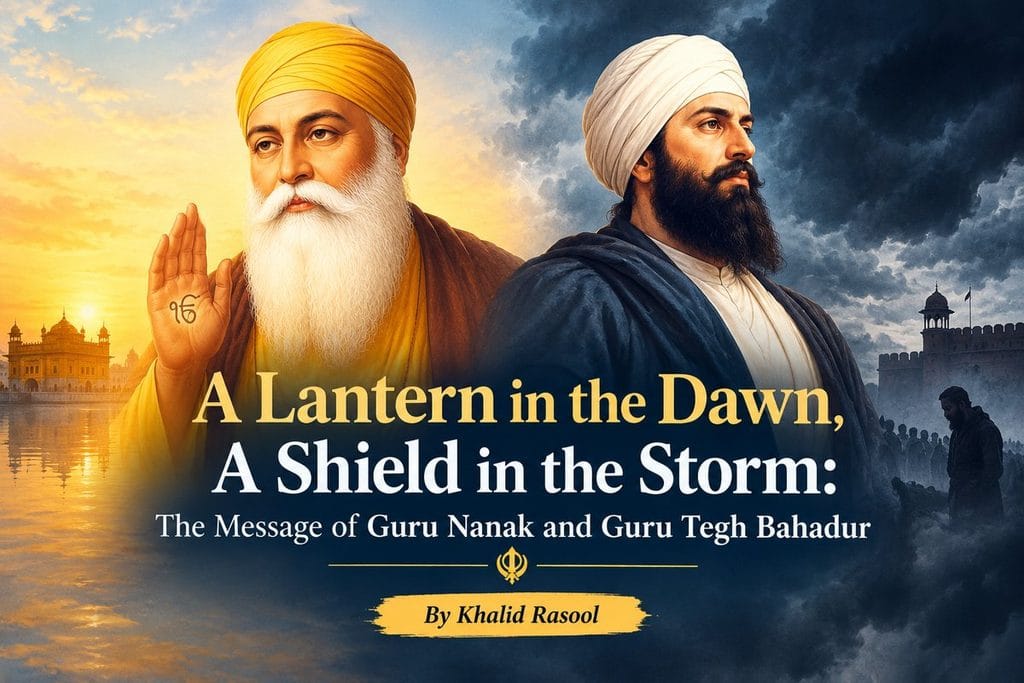
Before the first light touches the plains of Punjab, a quiet melody drifts over rooftops and courtyards. It is the sound of morning hymns, gentle and unhurried, welcoming the day with gratitude. In gurdwaras from Nankana Sahib to Nairobi, from London to Vancouver, lamps are lit and kitchens wake to feed whoever arrives at the door. In that quiet devotion and shared bread, two luminous lives speak to us across the centuries.
On 24 November 2026, Sikhs and well-wishers across the world mark the Gurpurab of Sri Guru Nanak Dev Ji. This year also brings the commemorations of the 350th anniversary of the martyrdom of Sri Guru Tegh Bahadur Ji towards their close. His supreme sacrifice in 1675 remains one of history’s most powerful testimonies to religious freedom and human dignity. Though separated by centuries and remembered through distinct occasions, the lives of these two great Gurus converge in one timeless message: humanity must stand above division, and freedom of conscience must be defended without fear. One Guru lit the lamp of universal kinship. The other stood in the fiercest wind so that the flame would not go out. Both left their words in the Guru Granth Sahib, the living scripture of the Sikhs, and those words still speak to a restless world.
The Dawn of Oneness
Born in 1469 in a village now called Nankana Sahib, Guru Nanak Dev Ji arrived in an age fractured by rigid hierarchies and bitter divides. He walked thousands of miles on foot, carrying a message as simple as it was revolutionary: Ik Onkar, there is One Creator, and that divine light dwells equally in every human heart. He rejected the idea that birth, caste, wealth or gender could make one soul superior to another. In its place he offered three pillars for a meaningful life: Naam Japo, to remember the Divine with humility; Kirat Karo, to earn an honest living through dignified work; and Vand Chhako, to share what one has with those in need.
At Kartarpur he gave these ideals a living form in the langar, a community kitchen where kings and labourers, scholars and outcasts sat on the same floor and ate the same meal. Faith, in his vision, is not measured by ritual alone but by what our hands do for others. His own words say it plainly: Ghal khai kichh hathahu dei, Nanak rahu pachhanahi sei, meaning that one who earns by honest labour and shares something from what he has truly knows the Way (Guru Granth Sahib, Ang 1245). He asked for living truth rather than lofty claims, and the scripture carries his reminder that sincerity of conduct stands above even the highest ideas about the Divine: Sachahu orai sabhu ko upar sach aachar, or truth is higher than everything, but higher still is truthful living (Ang 62).
His companionship was as inclusive as his teaching. Bhai Mardana, the Muslim musician who travelled beside him, gave the world one of its most beautiful pictures of friendship across faiths. The Guru Granth Sahib carries that spirit forward: beside the Sikh Gurus’ compositions it preserves the voices of Bhagat Kabir, Sheikh Farid, Bhagat Namdev and Bhagat Ravidas, seekers from different communities and backgrounds. Wisdom, it quietly says, has never belonged to one group.
The Shield of Conscience
More than a century later, that commitment to human dignity faced its gravest test in the ninth Guru, Sri Guru Tegh Bahadur Ji. He was a poet of deep serenity, whose hymns on detachment and fearlessness fill the closing pages of the Guru Granth Sahib. When Kashmiri Pandits came to him in despair, facing coercion to abandon their faith, he did not turn away because their rituals and scriptures differed from his own. He saw in their plight a threat to the sacred right of every person to live by their conscience.
In 1675, in the heart of Delhi, he gave his life, together with his devoted companions Bhai Mati Das, Bhai Sati Das and Bhai Dayala. He did not die to conquer territory or to assert one creed over another. He died so that people whose beliefs were not his own could keep them. History remembers him with reverence as Hind Di Chadar, the Shield of India. This is the heart of his legacy: he never demanded that others accept his beliefs, only that they be free to hold their own. His own verse had already named the mark of a true human being: Bhai kahu ko det nahi, nahi bhai manat aan, that one who neither frightens anyone nor is frightened by anyone is truly wise (Ang 1427). A society built on fear can never be at peace, and these words describe a different kind of strength, one that threatens no one and yields to no one, and that explains how a Guru could offer his life in defence of strangers.
One Moral Universe
The two Gurus lived in different centuries, yet they share one moral world. Guru Nanak taught us to see the divine in every human being. Guru Tegh Bahadur showed that recognising another person’s dignity can demand the courage to defend their freedom. The first opened the door of fellowship, and the second stood in that doorway when it was threatened. The scripture they shaped rests on a conviction that no wall between peoples can survive for long, one voiced in the Guru Granth Sahib by Bhagat Kabir: Avval Allah noor upaaya, qudrat ke sabh bande; ek noor te sabh jag upjeya, kaun bhale ko mande. First Allah created the Light, and by His power made all mortal beings; from the One Light the whole universe has sprung, so who is good, and who is bad? (Ang 1349)
A Message for Today
We live in an age of extraordinary connection, yet many hearts feel weighed down by new walls of suspicion, noise and division. South Asia is woven together by ancient rivers, shared languages and centuries of intertwined history. Its diversity has always been its deepest strength when nurtured with respect, and its deepest sorrow whenever prejudice was allowed to take root. Across this region and the wider world, communities still wrestle with fear of the unfamiliar and the temptation to reduce complex lives to narrow labels.
In such times, the Gurus’ legacy cannot be confined to ceremony or turned into a slogan for any agenda. Their light belongs to no faction. To our Sikh brothers and sisters, their lives are the heartbeat of faith and resilience. To Hindus, Muslims, Christians, Buddhists, Jains, and people of every belief or none, their message is an open doorway, an invitation to meet one another as fellow travellers on the same fragile earth. Peace cannot be built by asking people to abandon who they are. It grows when people can live their identities freely while granting others the same dignity. The Guru Granth Sahib describes the inner state from which such peace begins, a heart that has stopped dividing the world into friend and foe: Na ko bairee nahee begana, sagal sang hum ko ban aaee, meaning no one is my enemy, and no one is a stranger; I am at home with everyone (Ang 1299, Guru Arjan Dev Ji). Imagine the neighbourhoods, borders and public conversations of South Asia if even a part of that spirit took hold. Neighbours would be met as relatives and minorities as guests of honour, and rivals would be heard as fellow travellers who happen to disagree.
Beyond Remembrance
We do not honour the Gurus merely by lighting lamps, singing hymns or retelling stories of the past. We honour them in the ordinary, unglamorous choices of daily life: when we refuse to repeat a rumour that demeans a neighbour, when we earn our bread honestly and share our table generously, when we stand beside a vulnerable person whose faith, language or background differs from our own, and when we choose courage over silence in the face of hatred and injustice. This matters especially for the young people of South Asia, who grow up in a world where information travels instantly but understanding does not always follow. For them, these lives are lessons in leadership, service and ethical responsibility, and knowledge matters most in the wisdom with which it is used to lift others.
A Closing Prayer
As we remember the dawn that Guru Nanak brought into the world and the shelter that Guru Tegh Bahadur offered with his very life, may their wisdom soften our hearts and steady our steps. Let us become lanterns of kindness in dark places, shields for one another’s dignity, and tireless builders of a peace rooted in compassion, courage and love for all.
One humanity. One shared dignity. One enduring message of peace.